• Skip to main content
  • Skip to footer

Sue Hardman

Nourish + Rejuvenate

  • Start here
  • About Sue
    • Praise
    • Naturopathy & Herbal Medicine
  • Work With Me
    • Free Women’s Holistic Health Audit
    • 90-min Clarity Consultation
    • Total Transformation
  • Free Resources
    • Ditch the bloat in 3 days
    • End Your Sugar Cravings
  • Blog

hormones

Your Beauty Products & Your Hormones

December 12, 2017 By admin

Cleaning  Up Your Beauty Regime

I’m  pretty  choosy about my personal care products.

When I first learned about what was lurking in my products there wasn’t a whole lot of choice out there.

Fortunately, it’s becoming easier and easier to find products free of the ‘nasties’ that can contribute to many health issues.  

I sometimes make my own – I especially like make nourishing facial oils. 

Over the last few years there’s been an explosion in this space as more and more companies are creating cleaner lines in response to a growing interest in wellness and a greater scrutiny of questionable ingredients. 


Why skincare? 

Because our skin is our largest organ, and is also one of our 6 organs of detoxification. 

And because  sooooo … many of the chemicals that are used in products intended for the skin (think: lotions, shower products, make up, etc.) are made with chemicals that can negatively affect our health. 

 Do you know why the things that we put on our skin matters so much? I wanted to be sure that you have the knowledge to make healthier choices when you next choose what personal care products you’re going to buy. 

We’re often more concerned with what we put IN our body, than what we put ON our body but this month I wanted to talk about what you put on your skin whether it’s – shampoo, moisturiser,  deodorant or makeup.

Why,  you may ask?  

Many ingredients are known to be hormone disruptors and carcinogens. While manufacturers  may claim these ingredients are safe in small amounts.  The concern is that you’re exposed to so many toxins in our environment, we have no idea on the accumulative effect, so why add more fuel to the fire. 

Many of the ingredients in skin care products penetrate your skin and end up in your bloodstream.  

The EU has banned over 1000 cosmetic ingredients, but the FDA says safety for personal care products is the responsibility of the manufacturer. That’s not reassuring… So, it’s really up to you, the consumer, to become proactive. 

The average person is exposed to 126 unique chemicals in their personal care products alone, every day (US data). Now consider that your skin is your body’s largest organ, and is permeable to many synthetic chemicals that we come in contact with daily.  And studies have shown many of these chemicals do not break down, but simply accumulate in your body. 

And that makes sense since it’s very literally, and obviously going inside us and working its way through our body.  

When we consume things orally they enter our digestive tract, where they get absorbed, and then work their way over to the liver through the hepatic portal vein.  

Our liver is the workhorse of the metabolic process. This special organ is unique in that it has two separate blood supplies. One of these creates a closed loop; things enter the bloodstream, pass through the heart and make their way to the liver to be metabolised or broken down.  

After those things, harmful or otherwise, are filtered out and metabolised through the liver, the blood returns to circulation, and makes it’s way back to the heart, and the cycle continues.  

The second blood supply comes directly from the  digestive system.  

Things that we ingest hit the liver and get metabolised  before  making their way into the blood supply, which is a good thing.  

This is called First Pass Metabolism and it simply means that the liver gets a chance to metabolise the chemical, compound, nutrient, whatever it is, first.  

So what does this have to do with skin? 

Chemicals, compounds, etc, that enter the body through  absorption from the skin, and through inhalation actually  bypass this First Pass Metabolism. 

They move through the bloodstream before eventually making their way to the liver to be metabolised.  

So, even though the amount of chemicals we absorb can be significantly less than those we ingest, the fact that they bypass that initial metabolism can mean that those exposures can be more detrimental.  

This is why our skin care matters!  

While first pass metabolism might be technical, explaining this concept can help you see why shifting to safer skin care is so important.  

People are often feel conflicted about whether they should use up what they have, or toss everything and buy all new stuff.  

I say take it one step at a time! When something runs out, replace with a better, safer version.  
Skincare products (makeup, deodorant, cleansers, body wash and shampoos) are often full of chemicals, some which come with a known health risk.  

Parabens, for example, you may have noticed have been phased out of skin care products lately, with your favourite products now boasting they are “Now Paraben Free” – meaning that a lot of them, once upon a time, did include parabens.  

Parabens have been phased out  because they’ve been found to mimic oestrogen and are of concern for the formation of oestrogenic cancers, such as breast cancer. 


Because skincare is applied directly to the skin, a lot of it is absorbed into your bloodstream, so all of those unknown chemicals have a direct pathway to your liver.  

So, how do you reduce your toxin load and protect your skin from damage?

  • Firstly, I’d advise you to use things up before you buy a new product – no need to be wasteful.  
  • Educate yourself. Find out what chemicals you should be avoiding and why and it’ll make it easier for you to avoid them. 
  • Look up recipes to make your own products and give them a go! There are natural shampoo and conditioner solutions, cleansers, masks and even toothpaste you can try if you are keen.  
  • Choose products that have less chemicals it might take a bit of trial and error but it will be worth it in the long run. Your worth it (who says that again!!);  
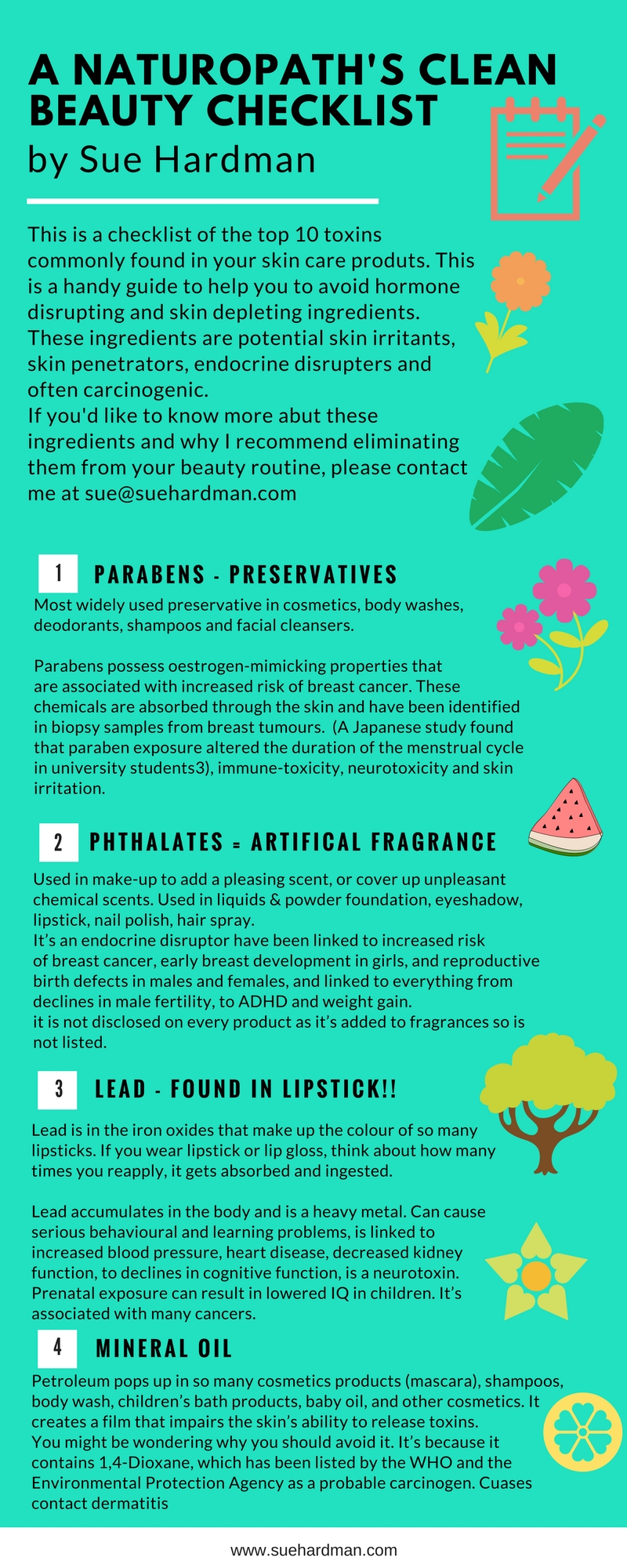
Download the complete free guide “A Naturopath’s Clean Beauty Check List – 10 Ingredients To Avoid”  so that you can start to clean up your beauty for long term health.


A Naturopath’s Clean Beauty Guide

Filed Under: blog Tagged With: beauty, clean beauty, detox, hormone balancing, hormone disruptors, hormones, infertility, Liver, menopause, metabolism, peri-menopause, PMS, skin, skin care, toxins, Womans health

Oestrogen Dominance – 9 ways to reduce it

October 31, 2017 By admin

oestrogen dominance Are Your Oestrogen Levels In The Right Balance? 

Hormones are the chemical messengers that control major body functions. Any imbalance can wreak havoc on your health. Some of the most important hormones for us to understand and keep in a healthy balance are our sex hormones.

Each hormone needs to be in the right balance for you. In 30’s your hormones will have different levels to when you’re 50.

As you enter perimenopause (usually after 40) through to the age of 50, there is an approximate 35% drop in oestrogen, and approx. 75% reduction in progesterone occurring simultaneously. This is considered normal, however because oestrogen and progesterone are so dependent on each other, the dramatic decrease in progesterone production leaves many women with symptoms of oestrogen dominance, even if oestrogen levels are lower than before.

Oestrogen is a fabulous hormone:
– it gives you hips, breasts, and thighs.
– It builds up the endometrial tissue in your uterus during your cycle ( important when having a baby).
– It protects your brain, heart, and bones

There’s more than one oestrogen, be sure to have the good one!

Oestrogen is not a single hormone but a group of hormones that are present in both men and women. They’re produced by adrenal glands, fat tissue, the ovaries and the testis.

The term “Oestrogen” is an umbrella term for three hormones – estradiol, estriol and estrone.

Estradiol is the most commonly measured type of oestrogen for non-pregnant women. Estradiol varies throughout the menstrual cycle. After menopause, estradiol production typically drops to a very low but constant level.

Estriol levels usually are only measured during pregnancy. And Estrone may be measured in women who have gone through menopause to determine their oestrogen levels.

Excess estradiol can be dangerous. Many diseases, including cancers and fibroids, are associated with too high estradiol levels.

To complicate matters, when oestrogen is broken down into metabolites in the liver, “good” or “bad” metabolites and they can either help or harm your health and wellbeing.

Oestrogen breaks down into 3 different type of metabolites. They are:

  • 2-Hydroxyestrone (or 2-OH for short)
  • 4-Hydroxyestrone (or 16-OH for short)
  • 16-Hydroxyestrone (or 16-OH for short)

2-OH is beneficial. You need to make at least 70% of this.

4-OH is mostly not beneficial. You want to make 10% or less of this.

16-OH is mostly not beneficial. You want to make no more than 20% of this.

Women who metabolise a larger proportion of their oestrogen via the 16-OH pathway may be at a significantly elevated risk of breast cancer compared with women who metabolise proportionally more oestrogen via the 2-OH pathway.

The “good” metabolites are known to have high antioxidant activity, which provides protection for the brain and heart.

The “bad” metabolites have been tied to cancer and weight gain.

It would make sense that you would want to do what you can to increase the good metabolites and decrease the bad metabolites, increasing the 2-OHE:16-OHE ratio. It is believed that by doing so we decrease the risk for a number of oestrogen-responsive cancers.

So what happens if your body is producing too much or too little oestrogen?

When women experience insufficient oestrogen, they can experience symptoms – including trouble sleeping, headaches, decreased labido, irregular periods, mood swings and hot flashes.

You want oestrogen sticking around, but you also want it to stay in check. When it starts running the show and knocks other hormones like progesterone out of whack, oestrogen imbalance occurs.

Whether it’s extra inches (especially) around the middle, ongoing fatigue, skin issues, trouble sleeping, PMS, PCOS, fibroids or fertility issues you may have a hormone imbalance.

Hormones can effect your size and shape and may be the reason you’ve struggled with losing weight and keeping those extra inches off. Too much fat below the belly button, hips and buttocks may indicate you have a hormone imbalance, in particular oestrogen dominance.

As oestrogen levels rise, controlling your weight becomes really difficult, because fat cells also produce oestrogen. So the more fat cells, the more oestrogen is released into your body, and the more your fat cells grow.

The following symptoms are common among those with oestrogen dominance. What begins with mild symptoms in younger years often becomes moderate in the mid to late 30s, and severe by the time a person reaches their mid-40s.

If you are experiencing some of these symptoms, you may be experiencing some level of oestrogen dominance. You’ll be in a far better place if you address your hormone imbalances when they are still mild, it will also mean you’ll have an easier transition to the menopause.

MILD MODERATE SEVERE
Premenstrual breast tenderness Irregular menstruation Uterine fibroid tumors
Premenstrual mood swings Weight gain Endometriosis
Premenstrual fluid retention, weight gain Hair loss Fibrocystic breasts
Premenstrual headaches Depression Polycystic ovary syndrome
Menstrual cramps Fatigue Breast tumors
Thyroid dysfunction Infertility
Adrenal gland fatigue Thickened uterine lining
Headaches, migraines Accelerated ageing
Severe menstrual cramps Miscarriage
Heavy periods with clotting Anxiety and panic attacks
Joint and muscle pain Autoimmune disorders
Decreased libido Impotency
Insomnia and restless sleep Oestrogen related cancer
Dry eyes
Lowered libido
Prostate problems

What can cause oestrogen excess?

Oestrogen is a vital hormone for many functions in your body, but if it’s not in it’s natural form or at the right level for you then it will interfere with your hormonal activity.

According to the work of Dr. John Lee, the balance of your body’s natural hormones are disrupted because we are living in a ‘sea of oestrogens’ as a result of:-

  • Eating non-organic animal foods with high levels of hormones i.e meat, diary, chicken.
  • Increased synthetic oestrogens found in things like plastics (BPA), medications, synthetic hormones (the pill and HRT) and chemicals from beauty products and chemicals in your environment.
  • Pesticides that mimic oestrogen in your body and send messages to the hypothalamus that it needs to keep producing more and more oestrogens.

Dr. John R. Lee coined the term ‘oestrogen dominance’ to describe what occurs when a woman has deficient, normal, or excessive oestrogen but little or no progesterone to balance oestrogen’s effects.

excess weight - a hormone problemEven low oestrogen levels can create oestrogen dominance symptoms if you’re also low in progesterone. In my practice, I’ve found that these factors can create oestrogen imbalance:

  • Being overweight or obese (fat cells produce excess oestrogen)
  • Being overly stressed (adrenal hormones are overly stimulated)
  • Poor diet choices
  • Autoimmune conditions
  • Gut conditions i.e. constipation and dysbiosis
  • Environmental toxins

Chemicals—called xenoestrogens— can set the stage for oestrogen dominance. One study found that mineral water with xenoestrogens leached from plastic packaging material could create oestrogenic activity, and sadly, these chemicals are all over the place in our modern world.

That being said, oestrogen dominance doesn’t occur in a vacuum. often when oestrogen gets out of balance, other hormones like insulin and cortisol can quickly follow. 

9 ways to take charge of your oestrogen levels so that you can have your best life: 

There are some simple changes you can make to your diet and lifestyle that may be just what the Doc ordered.

  1. Get more fibre – Plenty of complex carbohydrates and fibre from beans, lentils, wholegrains, vegetables and fruit. Fibre helps your body eliminate excess oestrogens. That’s why the saying ‘An apple a day keeps the doctor away’, is still so relevant to you today.Eat moderate amounts of protein – legumes, fish, eggs & chicken. Good fats such as nuts, seeds, oily fish and cold pressed vegetable oils. Eating enough fats and protein are key to ensuring the correct hormone levels in our body.
  2. Help your body detoxify daily by supporting your liver. Among its copious nutrients, studies show indole-3-carbinol (I3C)—prevalent in broccoli and other cruciferous vegetables—prevents the development of oestrogen-enhanced breast, endometrial, cervical, and other cancers.Eat ‘a cup a day’ of cruciferous vegetables (broccoli, cauliflower, cabbage, brussels sprouts and kale ) to help your liver produce enzymes and provide sulphur needed for the liver’s detoxification processes and help you liver remove the bad oestrogens and keep the good ones.Milk thistle is also an excellent herb for the liver as it not only supports detoxification but it also repairs liver cells.Liver-healing strategies include eating quality protein, garlic and onions, taking a B vitamin. 
  3. Heal your gut. Once the liver processes oestrogen for elimination, your gut moves it out. Gut issues mean oestrogen probably isn’t making its way out efficiently and instead could be recirculating in your body. As you can see, identifying and treating underlying causes of your digestive issues becomes crucial to balancing hormones.
  4. Do some exercise. Moderate to high intensity exercise helps your body maintain normal levels of oestrogen – according to research. Do a mixture of exercise, including aerobic and try increasing your muscle mass by doing strength building exercise.
  5. Avoid the following as best you can.
    Alcohol – it impairs the optimum functioning of your liver by making it difficult to metabolise and remove excess hormones.
    Pesticides – Wash if You Can or Go Organic. There are a variety of chemicals and pesticides found in your food or drink that exert oestrogen like activity when absorbed into the body. These are found on non-organic fruits and vegetables as well as animal products.
    Plastics – these are also similar in structure to oestrogen and confuse the body’s hormone balance because they mimic the body’s own oestrogen. Use BPA-free plastic, glass or metal containers for water.
  6. Reduce the following.
    Body fat because it stores chemicals, if you carry excess fat around the middle you will tend to have higher oestrogen levels.Chronic stress – any form of stress (nutritional, physical, chemical, mental, environmental) can increase your cortisol levels and disrupt hormonal balance. Cortisol becomes the predominant hormone and starts to reduce other hormones like progesterone and thereby increasing oestrogen levels. If yoga or meditation aren’t your thing, even five minutes of deep breathing or laughing with your best friend can help lower cortisol and reset estrogen levels.
  7. Supplement smartly. A functional practitioner can help you design an oestrogen-balancing supplement protocol.Optimal vitamin D is also crucial, as studies show sufficient vitamin D levels can inhi
    bit breast cancer cell growth. Ask your doctor or health care practitioner for a 25(OH)D test.
  8. Get tested. Lab testing can reveal whether and why you have oestrogen dominance. I like the DUTCH test which stands for “dried urine total complete hormones” and this has more benefits than other testing methods.

    The biggest and brightest names in health are reccomending the DUTCH test….Dr Mercola and Chris Kresser are all loving this test. If you would like to own your hormones, it starts with knowledge and I can help you.

  9. Sleep becomes mandatory to balance your hormones. If you have trouble drifting into eight hours of solid sleep nightly, try a relaxing tea, a warm bath.

The great news is that you CAN shift your hormones back into balance by following these steps, and reduce not only the inches but also the detrimental effect of excess oestrogen.


To find out more about how you can have optimum wellness as you enter your 40’s and feel radiant have vitality, and energy to do all that you want to have radiant skin, calm any digestive issues, cope better with stress, anxiety and have much higher long-lasting energy levels.


Schedule Appointment


5 Foods that will boost Your Energy Levels and Help You Lose Weight Naturally. 

GET YOUR FREE GUIDE HERE

You may  be struggling with low energy or wanting to lose your excess weight, you might have  tried a number of diets and strategies that haven’t worked for you.

I know how frustrating this can be, and how confusing it is to try to make sense of all the conflicting nutritional information out there.

I put this guide together so you can start to learn how and why specific foods, and drinks, can help you have more energy and lose weight naturally. The information I’m sharing is not about the latest fad diet; it’s about adding in nutrient-dense foods that have been proven to both aid in weight loss and improve overall health at the same time.

While some of this may be new to you, with a little bit of practice you will find it is easy to add these ingredients into your diet on a daily basis. In fact, at the end, I’m going to share one simple recipe you can make in under five minutes that incorporates all of these foods. How’s that for healthy eating on the go?

I’m excited to share this information with you, so let’s dig in!

GET YOUR FREE GUIDE HERE


Filed Under: blog Tagged With: anti-ageing, Balanced diet, belly fat, detox, fatigue, fertility, heart health, Herbs, hormone balancing, hormones, infertility, insomnia, Liver, menopause, metabolism, Milk Thistle, Natural Medicine, peri-menopause, Plant medicine, Plant Medicine 101, PMS, toxins, weight gain, Womans health

Part 2: Have You’re Hormones Suddenly Gone Crazy or Are You Perimenopausal?

August 10, 2013 By admin

In Part 1, we took a closer look at perimenopause (versus menopause) what the common signs are, how you can use food to address hormonal imbalances and how it can start as early as your 30’s (if you’re unlucky enough to experience that).

The 1st strategy included essential foods and how they can have such a huge impact on helping you balance your hormones. If you missed it you can read it on my blog here.

If, however, you’ve been following the recommendations and you’re still struggling with annoying and maybe debilitating symptoms, you may need a little more to get your body back into balance.

You might want to consider using some of nature’s medicines like herbs and a combination of nutritional supplements to address any deficiencies, that may have built up over the years.

Strategy #2: Which Supplements?

  • Women’s Multiple vitamin & mineral formula – most of us aren’t perfect, myself included, when it comes to getting all the nutrients you’re body needs on a daily basis from food. Taking a multi is my insurance policy, this way you can be guaranteed to get some of the basic nutrients you need everyday.Make sure it contains at least 50 – 100mg of Vitamin B. The British Journal of Obstetrics and Gynaecology, reviewed studies that show how Vitamin B6 is thought to be unique in its ability to increase the synthesis serotonin and dopamine, which if are too low have been implicated in hormonal symptoms or PMS.
  • Omega 3,6,9 or EFA’s (essential fatty acids – found in oily fish, chia and flax seeds) I can’t emphasise enough, how much you absolutely need good oil in your diet, forget the low fat craze it could be very detrimental to your body. EFA’s play an essential role in producing the hormones your body needs plus so many other things – the list is very long. You have to get your EFA’s from food or supplementation because your body cannot make them.If you have PMS, cramps or abnormal bleeding get yourself some Omega 3 & 6 as they are essential for the reduction of inflammation in these situations. Some options – flax or chia seeds (high in omega-3 fatty acids), borage oil (high in 3 and 6), evening primrose oil(high in 3 and 6), and fish oils (high in omega- 3 oils)·
  • Vitamin E – handy if you’re struggling with hot flushes or breast tenderness, consider taking a daily dose of 400 IU of natural vitamin E (as mixed tocopherols and tocotrienols) to help alleviate your symptoms.NB: This is a very short list of the essential supplements every women should consider taking as part of her daily routine. If you have specific issues and imbalances your nutritional requirements may be very different to someone else’s and might need a more in-depth investigation.

Strategy #3: Herbal Medicines

Herbs can be used with your new and frustrating symptoms of PMS or Perimenopause. You may need one or a combination of herbs. It all depends on whether you have low or high – oestrogen, cortisol, progesterone or testosterone levels?

If your treating yourself at home, try one herb at a time or better yet consult a qualified herbalist as they use combinations based on your situation.

The most well known herbs used are those that contain phytoestrogens (soya, red clover, fennel, licourice, dong quai, black cohosh), with oestrogen like effects in the body. However a hormonal imbalance is never so simple and often requires a combination of herbs and actions.

The most commonly herbs used for perimenopause include:-

  • Dong quai – is known both in China and the West for its ability to support and maintain the natural balance of female hormones. Avoid if with heavy bleeding.
  • Black cohosh – One of the best-studied herbs used for supporting and maintaining your hormonal levels and lessening the severity of hot flashes. In one of the largest studies, results showed as early as 4 weeks, clear improvements in the menopausal ailments in 80 percent of the women. Complete disappearance of symptoms occurred in approximately 50 percent. Symptoms included hot flashes, night sweats, headaches, insomnia and mood swings. The other studies reported improvements in fatigue, irritability, hot flashes and vaginal dryness
  • Hops contains a potent phytoestrogen and is used for hot flushes associated with anxiety or stress, and associated insomnia (sleeplessness).

However a herbalist might also consider including the following herbs in a formula:-

  • Siberian ginseng – is one of my all time favorite herbs and I take this regularly as it reduces mental and physical fatigue, and helps to enhance the ability to cope with various physical and mentalstressors by supporting you’re adrenal glands. It has also been used to treat vaginal changes, like dryness, due to lack of oestrogen. Ginseng is for you if you’re – stressed, tired or perimenopausal.
  • St John’s Wort – is not a phyto-oestrogen herb but it can be very useful for hot flushes triggered by anxiety or stress. It can also be used for mild to moderate anxiety and depression associated with hormones.
  • Other herbs that would be considered are – red clover, lemon balm, oats, passiflora, ashwaganda, shatavari plus many more.

Your situation might be very different to someone else’s – none of us are alike.  If you’re confused or tired of trying a number of things that aren’t working then it might be a good time to start dealing with the cause and imbalances.

If you really want to find a solution for what’s going on in your body and causing you a lot of unhappiness or frustration, my detailed hormonal questionnaire will help us identify where exactly your imbalances are so that your issues can be addressed correctly, without guessing, and help you get started on your journey to optimal health and wellness.

Please do get in touch you can contact me at sue@suehardman.com

If you don’t want to miss any future newsletters or blogs please sign up here  in the sign-up box. 

Filed Under: blog Tagged With: Headache, Herbs, hormone balancing, hormones, insomnia, menopause, Natural Medicine, peri-menopause, Plant medicine, Womans health

  • « Go to Previous Page
  • Page 1
  • Page 2
  • Page 3

Footer

Recent Posts

  • Non-stick pans are they making you ill?
  • Stress is Not Good For Your Immune System
  • Hummus so much more than a dip

Copyright © 2026 · Genesis Sample on Genesis Framework · WordPress · Log in